Fantasy Football 101
Fantasy football positions explained: RB, WR, FLEX
Learn what QB, RB, WR, TE, FLEX, K, and DST mean in fantasy football, then see which positions matter most by scarcity and scoring.
By Mike Yan · June 9, 2026 · 8 min read
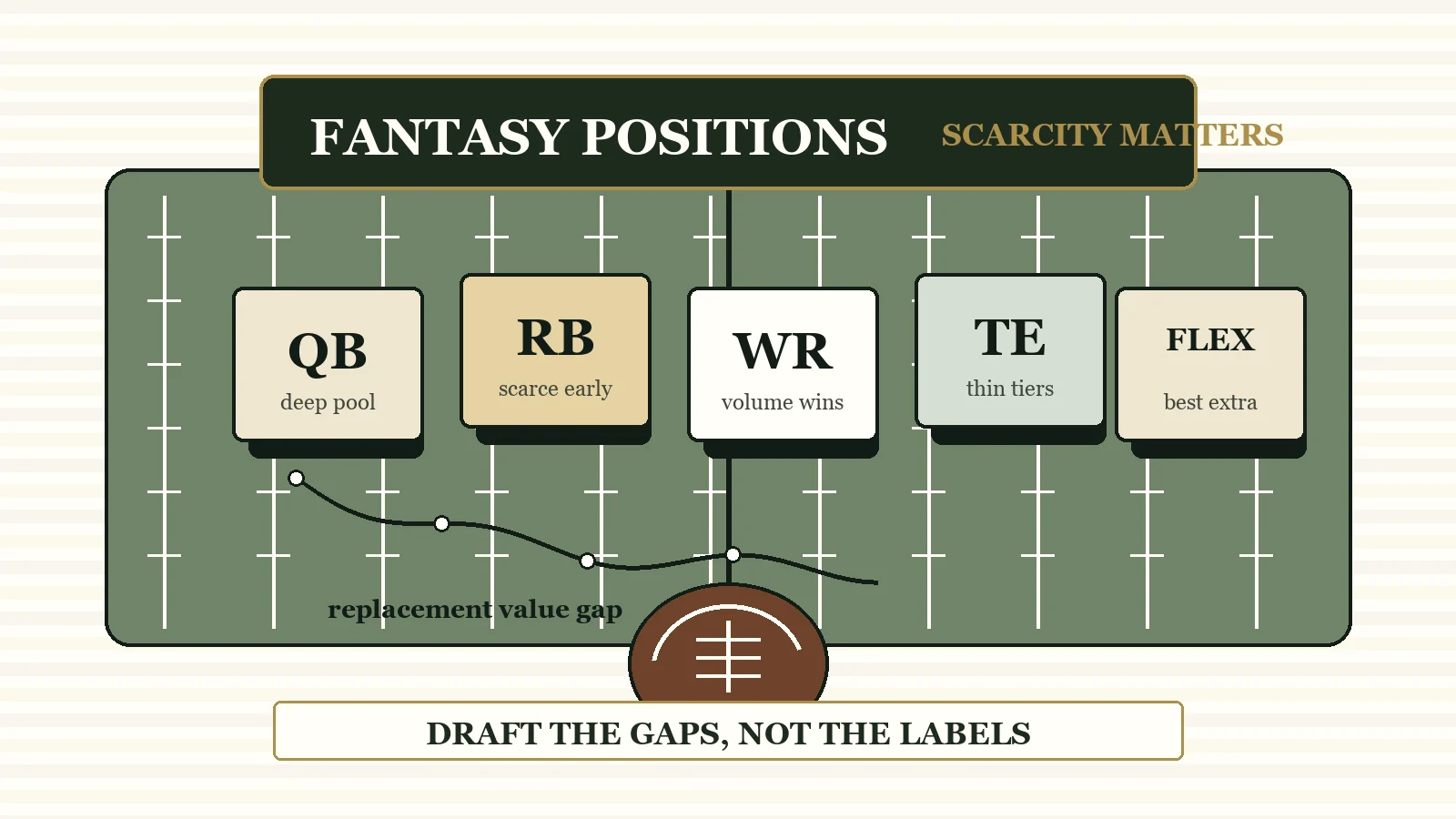
Field notes from the Fantasy Butler desk.
Fantasy football positions are the roster slots you fill with NFL players: QB, RB, WR, TE, FLEX, K, and DST. The positions that matter most are the ones where startable players run out fastest. In normal leagues, that usually means RB, WR, and the FLEX pool. QB changes everything only in superflex or two-QB formats.
If you joined the office league and are trying not to be the person asking what “W/R/T” means while the draft clock runs, start here. The labels are simple; value comes from scarcity.
Fantasy football positions at a glance
Most fantasy football leagues use the same basic position map. Yahoo lists the core abbreviations as QB, RB, WR, TE, K, D/ST, and several flex combinations. Draft Sharks describes the common lineup as one quarterback, multiple running backs and wide receivers, one tight end, often a flex, plus kicker and defense.
| Position | Meaning | What you need to know |
|---|---|---|
| QB | Quarterback | Usually starts one per team. Valuable, but often deep in normal leagues. |
| RB | Running back | Usually starts two. Scarcity matters because true lead backs disappear quickly. |
| WR | Wide receiver | Usually starts two or three. Deeper than RB, but volume matters in PPR. |
| TE | Tight end | Usually starts one. A few are comfortable; many are weekly guesses. |
| FLEX | Flexible starter | Usually RB, WR, or TE. This is where depth becomes weekly points. |
| K | Kicker | Usually starts one. Draft late. Do not overthink it in a beginner league. |
| DST | Defense/special teams | Usually starts one team defense. Often streamed by matchup. |
The table tells you what each label means. Scarcity tells you how to draft.
Why position scarcity matters
Position scarcity means a position runs out of dependable starters faster than another one. Athlon’s beginner scarcity guide puts the idea plainly: value depends on how many usable players exist at a position compared with how many starters your league requires.
That is why fantasy drafts do not simply follow raw NFL talent. The best quarterback may score more points than the best running back, but if 10 other quarterbacks are still useful and only three safe running backs are left, the running back can be the better pick.
The cleaner term is replacement value. A player is valuable when he beats the realistic replacement you could find later. Fantasy Football Analytics explains value over replacement with the same logic: compare a player against a typical player at his own position, not against every player in the draft.
For a newcomer, translate that this way: if passing on a position leaves you with a weekly headache, that position was scarce.
Why RB and WR usually drive the room
Running back and wide receiver matter because most leagues start several of them. Footballguys’ starting-lineup guide uses a vanilla lineup of QB, RB, RB, WR, WR, TE, D/ST, and K, then notes that modern leagues often add another WR or a flex.
In a 12-team league with two RB slots, the room needs 24 starting running backs before anyone uses a flex. Add FLEX and benches, and the useful backs dry up faster. That does not mean draft any RB at any price. It means you should notice when the board moves from clear starters to committee players.
Wide receiver is usually deeper, but scoring can push it up. In PPR or half-PPR, steady targets become weekly floor. ESPN’s scoring support explains that PPR adds a point for each catch, while standard scoring does not. That single setting makes target-heavy receivers and pass-catching backs more valuable.
This is why the RB vs WR question is not a personality test. It is a settings question. If your league starts three WRs and a FLEX, receiver scarcity can become real. If your league starts two RBs and the waiver wire is thin, running back scarcity can punish you for months.
What FLEX actually does
The FLEX spot lets you start a player from more than one eligible position, usually RB, WR, or TE. Sleeper’s flex guide says a standard flex can use RB, WR, or TE, while superflex can include QB. Yahoo uses W/R/T for wide receiver, running back, or tight end, and Q/W/R/T when quarterbacks are eligible.
The mistake is thinking FLEX is a bonus position. It is really a roster-depth test.
If your third running back is stronger than your third receiver, FLEX lets that running back score for you. If your receiver bench is deeper, FLEX lets you use the extra target volume. If your tight end is only touchdown-dependent, FLEX usually should not be where you force him in.
Players do not score extra points because they are in FLEX. The same scoring rules apply. FLEX simply lets your best extra RB, WR, or TE enter the lineup.
How each position should feel to a beginner
Quarterback
In a normal one-QB league, quarterback is important but often less scarce than it looks. There are 32 NFL starters, and your league may start only 10 or 12 fantasy quarterbacks each week. That is why many drafts let you wait unless the league uses superflex or two-QB settings.
In superflex, the math changes. Footballguys notes that two-QB and superflex formats push quarterback scarcity up because many more QBs must start every week. If your office league has superflex, do not use normal beginner draft advice without adjusting.
Running back
Running backs create the most anxiety because secure workloads are rare. Lead backs get carries, goal-line chances, and sometimes targets. Committee backs may need an injury or touchdown to become comfortable starts.
That is why RB scarcity drives early-round value. You are buying projected points and relief from a weekly waiver search. A weak RB room is one of the fastest ways fantasy turns into a second job.
Wide receiver
Wide receiver is usually deeper because NFL teams play several receivers and fantasy leagues often start several of them. The trick is volume. A receiver getting eight targets a week is easier to trust than a big-play receiver who needs one deep catch to save his score.
This is where fantasy football scoring matters. Full PPR and half-PPR reward catches, so WRs with steady target shares rise. Standard scoring rewards yardage and touchdowns more heavily, so boom-bust receivers can look better than they feel.
Tight end
Tight end is simple until it is painful. A few tight ends behave like weekly advantages. After that, many managers chase touchdowns, matchups, and two-catch stat lines.
For a beginner, the practical rule is calm: take a top tight end if the value is right, or wait and accept that the position may be a weekly choice. Do not draft a second tight end into FLEX unless he is clearly better than your RB and WR options.
Kicker and defense
Kicker and defense matter in weekly matchups, but they should not control your draft. Most beginner leagues can draft them late and adjust during the season.
Defense is often matchup-driven. Kicker is often tied to team environment. Neither should pull you away from startable RB, WR, or FLEX depth in the middle rounds.
The draft priority I would use in an office league
For a normal beginner or office league, use this order of attention:
- Learn your scoring first, especially PPR, half-PPR, or standard. If those terms are new, read the PPR fantasy football guide.
- Fill RB and WR with players who have weekly roles rather than highlight clips.
- Treat FLEX as your best extra RB or WR unless a tight end is truly strong.
- Do not panic at QB in a normal one-QB league.
- Do adjust immediately if the league is superflex or two-QB.
- Draft kicker and defense late.
- Use ADP as a market signal, not as a command.
If you want the broader beginner path, start with the fantasy football beginner guide.
FAQ
What are the main fantasy football positions?
The main fantasy football positions are quarterback (QB), running back (RB), wide receiver (WR), tight end (TE), FLEX, kicker (K), and defense/special teams (DST). Some leagues also use superflex, which can include quarterbacks, or individual defensive player positions.
What does RB mean in fantasy football?
RB means running back. Running backs score through rushing yards, receiving yards, touchdowns, and sometimes receptions, depending on the league settings. They are often valuable because secure workloads are scarce.
What does WR mean in fantasy football?
WR means wide receiver. Wide receivers score through catches, receiving yards, and touchdowns. They gain value in PPR and half-PPR leagues because reception scoring rewards steady target volume.
What is the FLEX position in fantasy football?
FLEX is a lineup spot that can usually be filled by a running back, wide receiver, or tight end. Some leagues use superflex, which also allows quarterbacks. FLEX does not add bonus points; it gives you another way to start your best eligible player.
Is RB or WR better in FLEX?
Use the player with the best combination of workload, scoring fit, and matchup. In PPR, a steady wide receiver can beat a touchdown-dependent running back. In standard scoring, a running back with goal-line work may be safer.
Which position should I draft first?
In most normal leagues, early picks usually come from RB and WR because those positions fill multiple starting slots and drive FLEX decisions. The exact answer depends on scoring, draft slot, player tiers, and whether your league uses superflex.
Does quarterback matter in fantasy football?
Yes, but quarterback scarcity depends on format. In a normal one-QB league, useful quarterbacks are easier to find. In superflex or two-QB leagues, quarterback becomes one of the most important positions because the whole league needs more starters.
Do kickers and defenses matter?
They matter each week, but they rarely deserve early draft capital. Draft them late, then manage them by matchup if your league format allows it.
Closing
Fantasy football positions look like abbreviations. They are really supply and demand.
QB, RB, WR, TE, FLEX, K, and DST all score points, but they do not create the same draft pressure or weekly workload. Learn which positions run out fastest, read your scoring, and build a roster that does not force you into 17 weeks of repair work.
Want FB to set your lineup for you? -> Connect your league.
The Fantasy Butler Team
A small desk focused on fantasy operations, time back, and the work of making every roster move happen on schedule.