Fantasy Football 101
Fantasy football scoring: every format compared
Fantasy scoring rules decide more than point totals. Here's how PPR, half-PPR, standard, superflex, bonuses, and defense change your draft.
By Mike Yan · June 2, 2026 · 12 min read
Field notes from the Fantasy Butler desk.
Fantasy football scoring turns NFL box-score stats into fantasy points. The part most new and returning managers miss: scoring is more than postgame math. It is the rulebook that decides which players matter, which rankings sheet you should use, and how much weekly work your roster will demand.
If you are coming back after a few years away, or joining an office league and trying not to be the person who drafts from the wrong cheat sheet, start here. Read the scoring settings before you read the rankings.
How fantasy football scoring works
Fantasy football scoring assigns points to real NFL events: passing yards, rushing yards, receptions, touchdowns, interceptions, sacks, field goals, defensive scores, and sometimes bonuses. Your weekly matchup is usually head-to-head. Your lineup earns points from the players you started, and your opponent’s lineup does the same.
The common offensive baseline looks familiar across the major platforms:
| Stat | Common scoring value | Why it matters |
|---|---|---|
| Passing yards | 1 point per 25 yards | Keeps quarterback scoring high without making every passer a league-winner. |
| Passing touchdowns | 4 or 6 points | A 6-point passing TD league pushes quarterbacks up draft boards. |
| Interceptions | -2 points | Penalizes volatile quarterbacks. |
| Rushing yards | 1 point per 10 yards | Makes rushing volume the running back floor. |
| Receiving yards | 1 point per 10 yards | Makes downfield receivers spike in any format. |
| Rushing or receiving touchdowns | 6 points | Touchdown-heavy players matter more in standard scoring. |
| Receptions | 0, 0.5, or 1 point | The single setting that changes the most draft values. |
Those values are not universal. ESPN’s scoring page lists 4 points for passing touchdowns, 1 point per 25 passing yards, 6 points for rushing and receiving touchdowns, and 1 point per 10 rushing or receiving yards as standard settings. NFL.com default scoring uses the same broad offensive spine while also listing receptions at 1 point.
The lesson is simple: the label on your league is useful, but the settings page is the truth.
PPR, half-PPR, and standard scoring
The scoring format most managers talk about first is reception scoring. It has three common forms.
| Format | Reception value | Who gets helped |
|---|---|---|
| Standard or non-PPR | 0 points per catch | Touchdown scorers, downfield receivers, rush-heavy running backs |
| Half-PPR | 0.5 points per catch | Balanced receivers, pass-catching running backs, usable tight ends |
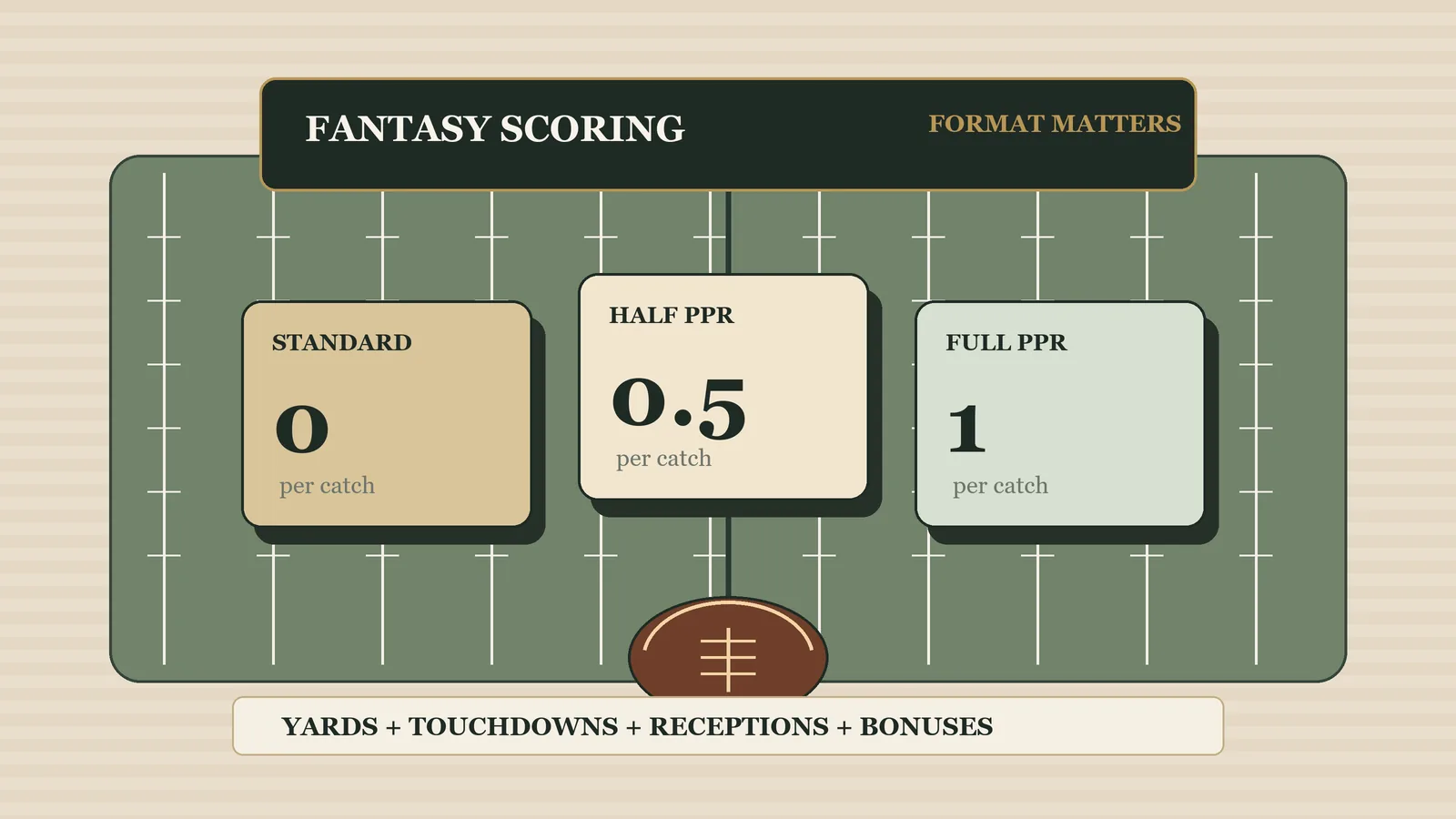
| Full PPR | 1 point per catch | Target earners, slot receivers, checkdown backs, high-volume tight ends |
ESPN explains the difference directly: PPR gives a point for each catch, while standard scoring gives no extra point for the catch itself. Yahoo’s default football settings use 0.5 points per reception, and Yahoo’s 2026 beginner guide describes the default as half-PPR. That is why many managers think of half-PPR as the modern middle ground.
That half-point sounds small. It is not small over a season.
A running back with 60 catches gets 60 extra points in full PPR, 30 in half-PPR, and 0 in standard. That changes who is “safe.” In full PPR, a back who catches five short passes can survive a game with no touchdown. In standard, that same back needs yardage or a score. The player did the same thing on the field. Your league valued it differently.
This is why you cannot draft from a random rankings list. A full-PPR receiver board and a standard receiver board are not interchangeable. A player who is comfortable in one scoring format can become a weekly decision problem in another.
Why scoring changes your draft
Scoring settings are the first filter on your fantasy football draft strategy. They tell you which player archetypes your league pays.
In full PPR, you should care more about targets and route stability. A wide receiver who earns eight targets a week has a high floor even if his average depth of target is not exciting. A running back who plays on third downs has real value even if he is not the goal-line back. A tight end with steady catches can be less painful than a touchdown-only tight end who gives you two points six times a year.
In standard scoring, touchdown equity and yardage spikes matter more. The short-area slot receiver loses some weekly floor. The two-down power back can hold value if he owns goal-line work. The boom-bust wide receiver becomes easier to justify because one long touchdown can win the week.
Half-PPR sits between those worlds, but it is still not neutral. It gives volume players enough credit to matter without turning every four-yard catch into a major event. For new managers, half-PPR is usually the easiest scoring format to understand because it rewards both real football progress and fantasy volume. That is why the PPR and half-PPR distinction is worth learning before draft night.
The mistake is treating scoring as trivia. It is not. It is the market. If your league rewards receptions and you draft like receptions do not matter, you spend the season fixing your roster on waivers. That is how fantasy turns into a second job.
The settings to check before you draft
Before you open rankings, check these six settings in your league.
Reception value
This is the big one. Is each catch worth 0, 0.5, or 1 point? Match your rankings sheet to that number. If your league is half-PPR, use half-PPR rankings. If it is full PPR, use full PPR rankings. Close enough is not close enough when the setting touches every running back, wide receiver, and tight end.
Passing touchdown value
Most default settings give quarterbacks 4 points for a passing touchdown. Some leagues give 6. That two-point difference matters because quarterbacks throw many more touchdowns than most players score. In 6-point passing TD leagues, elite quarterbacks move up. In 4-point leagues, you can usually wait longer at the position unless your league has superflex.
Superflex or two-quarterback slots
Superflex means a flex spot can start a quarterback. Two-QB means you must start two. Either way, quarterback scarcity changes immediately. In a single-QB league, 10 to 12 quarterbacks start each week. In a 12-team superflex league, 20 or more can matter. The same scoring table creates a very different draft when the lineup slots change.
This is where scoring and roster settings meet. A quarterback’s points only matter if there is a starting slot where those points can be used.
Tight-end premium
Tight-end premium gives tight ends extra points for receptions, usually 1.5 PPR for tight ends while other positions get 1.0 or 0.5. That setting pushes the best tight ends up and makes mid-tier tight ends less disposable.
If you miss this setting, your draft can break quickly. You will think the room is reaching on tight ends. The room is not reaching. The room read the settings.
Yardage and big-play bonuses
Some leagues add bonuses for 100-yard rushing games, 100-yard receiving games, 300-yard passing games, 40-yard touchdowns, first downs, or long field goals. Sleeper’s scoring-options support page is a good reminder that modern platforms can expose a long menu of custom categories.
Bonuses help spike-week players. They also add variance. A league with big-play bonuses can be fun, but it may create more weekly start/sit stress because the upside case gets louder.
Defense and kicker scoring
Defense scoring is often ignored until it swings a matchup. NFL.com’s default scoring gives defenses points for sacks, interceptions, fumble recoveries, safeties, touchdowns, and points allowed. Some leagues go further with yards allowed, return yards, three-and-outs, or big negative penalties.
If defense scoring is aggressive, streaming defenses becomes real weekly work. If it is quiet, you can treat defense as a low-attention position. That is the operational lens again: the setting tells you how much of your week the position is going to ask for.
A simple scoring checklist
Use this before every draft.
- Open your league settings.
- Find receptions and write down
0,0.5, or1. - Find passing touchdowns and write down
4or6. - Check whether the lineup has superflex, two-QB, extra flex, or tight-end premium.
- Scan for bonuses: big plays, first downs, long field goals, yardage milestones.
- Check defense and kicker scoring for extreme settings.
- Pick rankings that match your format.
- Draft players whose value comes from what your league actually rewards.
That last line is the whole game. If your scoring rewards catches, draft target earners. If your scoring rewards touchdowns, draft touchdown paths. If your scoring rewards quarterbacks through superflex or 6-point passing TDs, do not wait until Round 10 because a single-QB article told you to.
The same principle applies to ADP. ADP tells you when the room usually takes a player. Scoring tells you whether that player is worth taking in your room.
How scoring affects weekly management
Draft mistakes are visible on draft night. Scoring mistakes hide until the season starts.
In full PPR, your weekly lineup decisions often come down to volume. Is the slot receiver getting seven targets? Is the pass-catching back still on the field for third downs? Is the tight end earning enough short catches to survive without a touchdown?
In standard scoring, those questions change. Touchdown odds matter more. Carries inside the 10-yard line matter more. Deep targets matter more. A player can look busy and still produce a quiet fantasy score if the league does not reward catches.
In bonus-heavy scoring, variance rises. A player with a 40-yard touchdown bonus can jump a matchup on one play. A quarterback with 300-yard bonuses can outscore his baseline projection. A defense with heavy points-allowed scoring can produce a 20-point swing if you pick the right matchup.
Each setting creates a management style. High-variance scoring pushes you toward more weekly decisions. Balanced scoring lets more of your roster run quietly. Neither is wrong. The mistake is drafting a high-maintenance format while pretending it will run like a low-maintenance one.
This is why Fantasy Butler frames scoring as an operations problem instead of a beginner definition. The goal is not to memorize every scoring category. The goal is to know which settings will create work for you every week, and either draft around that work or build an execution layer that handles it.
What a good fantasy score means
There is no universal “good score” in fantasy football because scoring settings change the scoreboard.
A score that is strong in a conservative standard league can be ordinary in full PPR with yardage bonuses, extra flex spots, and 6-point passing touchdowns. In superflex, weekly totals climb because most teams are starting another quarterback. In shallow leagues, scores rise because every lineup is filled with better players.
Do not judge your team against a generic number. Judge your team against your league.
The useful questions:
- What is the average winning score in this league?
- What does a playoff-level weekly score look like?
- Which positions produce the biggest weekly gap?
- Which scoring settings create the biggest surprise swings?
After Week 3, your own league’s scoreboard is more useful than any generic article. Before Week 1, the best proxy is your league settings plus the platform defaults.
One more wrinkle: scores can change after Sunday. Yahoo notes that football stat corrections can be applied until the first real-life game in the next matchup week on its scoring overview. NFL.com also explains that official stat reviews can change fantasy totals after the fact in its scoring article. If a matchup moves by a point on Tuesday, this is usually why.
The format recommendations I would actually use
For a beginner or office league, I would use half-PPR, 4-point passing touchdowns, one normal flex, no superflex, no tight-end premium, and modest defense scoring.
That setup is not exotic. That is the point. It rewards receiving volume without making every catch too powerful. It keeps quarterbacks important without turning the draft into a QB race. It gives managers enough weekly choices to stay engaged without burying the reluctant coworker in settings they did not know existed.
For a sharper home league, full PPR or half-PPR with superflex can be excellent. Just know what you are buying. Superflex makes quarterbacks expensive. Tight-end premium makes the position matter more. Big-play bonuses make weekly scores less predictable. Those settings can improve a league when everyone understands them. They can also punish the manager who joined because fantasy was supposed to be casual.
For a league where people keep abandoning teams by Week 8, simplify scoring before you add more rules. The problem may not be that the league needs more complexity. It may be that the settings are creating more maintenance than the managers signed up for.
FAQ
How does fantasy football scoring work?
Fantasy football scoring gives points for real NFL stats. Passing yards, rushing yards, receiving yards, touchdowns, receptions, interceptions, sacks, field goals, and defensive plays can all count depending on your league settings. Your lineup’s points are added for the week and compared with your opponent’s points.
What is the difference between PPR, half-PPR, and standard scoring?
PPR gives 1 point per catch. Half-PPR gives 0.5 points per catch. Standard or non-PPR gives no extra points for catches. PPR raises the value of pass-catching running backs, target-heavy wide receivers, and steady tight ends. Standard scoring leans more toward yardage and touchdowns.
Is PPR better than standard scoring?
For most beginner and office leagues, half-PPR is the best default because it balances catch volume with real football production. Full PPR is good if the league wants higher scoring and more stable receiver floors. Standard scoring is simpler but more touchdown-dependent.
What is a good fantasy football score?
A good score depends on the league. A total that looks strong in conservative standard scoring can be ordinary in full PPR, superflex, or bonus-heavy formats. Compare your team with your league’s weekly average and winning scores, not a universal number.
How do quarterbacks score fantasy points?
Quarterbacks usually score through passing yards, passing touchdowns, rushing yards, rushing touchdowns, and two-point conversions. They lose points for interceptions and sometimes fumbles. The key setting is passing touchdown value: 4-point passing TD leagues let you wait longer at quarterback, while 6-point passing TD or superflex leagues push quarterbacks up.
How does defense scoring work?
Team defenses usually score for sacks, interceptions, fumble recoveries, safeties, defensive touchdowns, and points allowed. Some leagues also score yards allowed, return yards, or custom categories. Heavy defense scoring makes weekly defense streaming more important.
What scoring format should beginners use?
Use half-PPR, 4-point passing touchdowns, one flex, no superflex, no tight-end premium, and simple defense scoring. That setup is familiar, easy to find rankings for, and balanced enough that one weird rule does not dominate the draft.
Can stat corrections change my fantasy football score?
Yes. Official stat corrections can change fantasy totals after games finish. Yahoo and NFL.com both explain that reviewed NFL statistics can affect fantasy scores and matchup results after the original game-day total.
Closing
Fantasy football scoring looks like a settings page. It is really the league’s operating system.
Read it before you draft. Match your rankings to it. Know which positions it rewards. Then build a roster that fits the season you actually have time to run.
If you want fantasy football to stop becoming a second job after the draft, the scoring page is the first place to look. The next step is letting Fantasy Butler handle the in-season work: lineups, waivers, FAAB, injury swaps, and the small Sunday decisions that keep piling up.
The Fantasy Butler Team
A small desk focused on fantasy operations, time back, and the work of making every roster move happen on schedule.